Ceres' bright spots: Icy volcanoes?

Mysterious bright spots on Ceres could turn out to be icy volcanoes that blast water vapor into space, raising the possibility that a life-giving ocean exists beneath the surface of the dwarf planet, according to images from the Dawn probe.
Another possibility is that the plumes result from sun-warmed icy patches, much like the tail of a comet.
Scientists presented those tantalizing theories this week at the Lunar and Planetary Science conference outside Houston. But they won't begin to know for sure until after mid-April, when Dawn emerges from the dark side of Ceres, the largest and roundest object in the asteroid belt between Mars and Jupiter.
In January 2014, the first definitive detection of water vapor on Ceres was made by the Herschel space observatory. Nine years earlier, images from the Hubble space telescope had suggested the possibility of water ice.
Two light spots appeared inside a crater in black-and-white images beamed back in mid-February as Dawn closed in on Ceres. During one full, nine-hour rotation, the probe showed that the brightest could be seen even from the side, indicating it extends over where the crater rim appears to be.
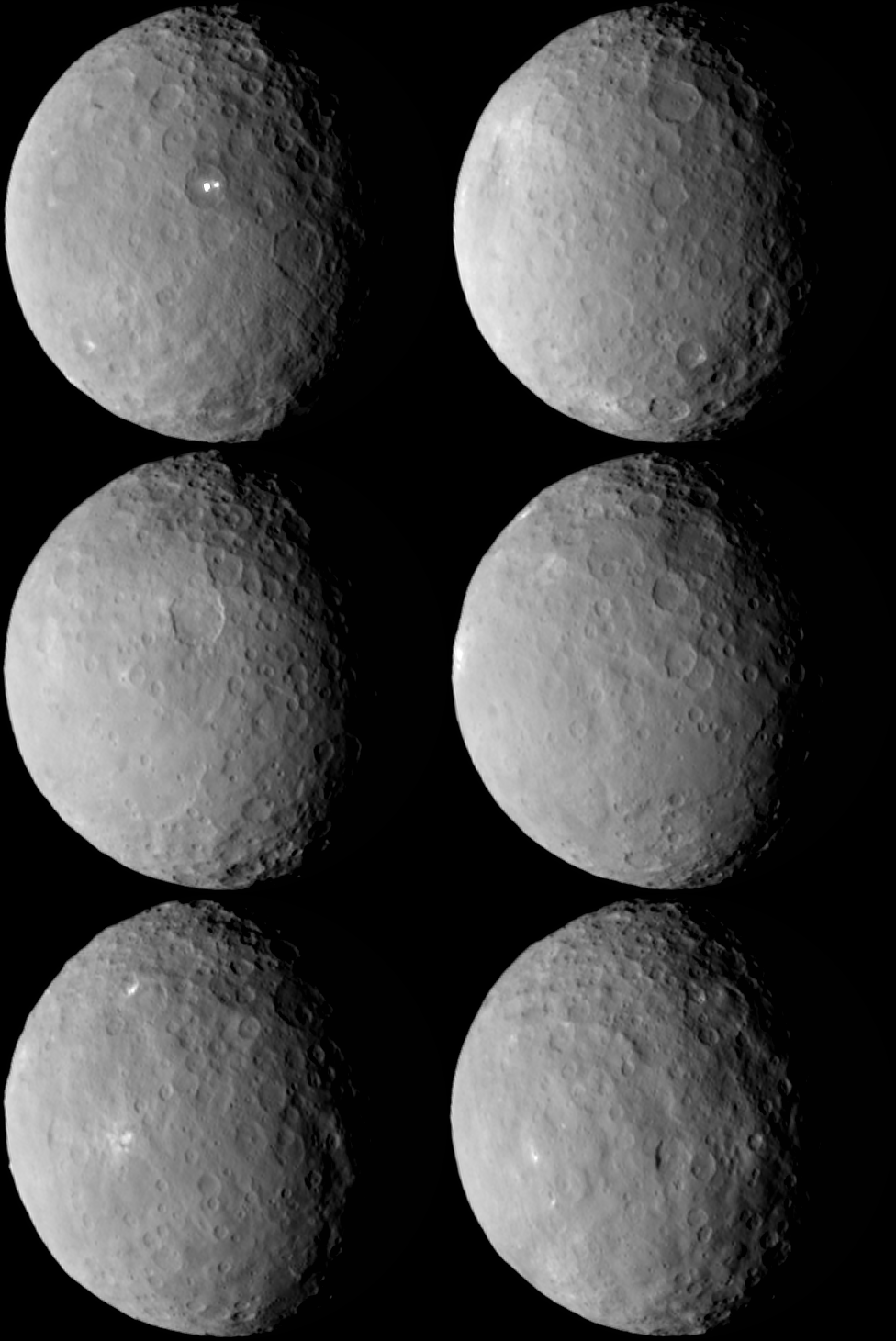
"We believe this could be some kind of outgassing," the camera's supervisor, Andreas Nathues, said Tuesday, New Scientist reported.
Another scientist cast doubt that the plumes are caused by cryovolcanism — ice volcanoes. David O'Brien, of the Planetary Science Institute in Tucson, said Ceres lacks the internal forces to create such eruptions.
Others theorized that the vapor blasts might be similar to emissions from comets.
"Could the bright spot be an icy plume caused by the vaporization of Ceres' surface as it turns towards the sun's heat, and then dropping away as night falls?" wrote Monica Grady, a professor of planetary and space sciences at the Open University. "Corridor talk at the conference speculates that Ceres might be closer to a comet than the asteroid it is usually regarded as."
But Timothy Titus, of the U.S. Geological Survey in Flagstaff, Ariz., offered a model that challenges the comet comparison, saying such action could occur only at the poles of Ceres, not where the spots are located.
Regardless, the talk of the conference is whether Ceres might someday be habitable.
Launched in September 2007, Dawn has traveled more than 3.1 billion miles on its journey to Ceres, which is 310 million miles from Earth. Before entering the body's gravitational pull in early March, the probe had studied the asteroid Vesta.